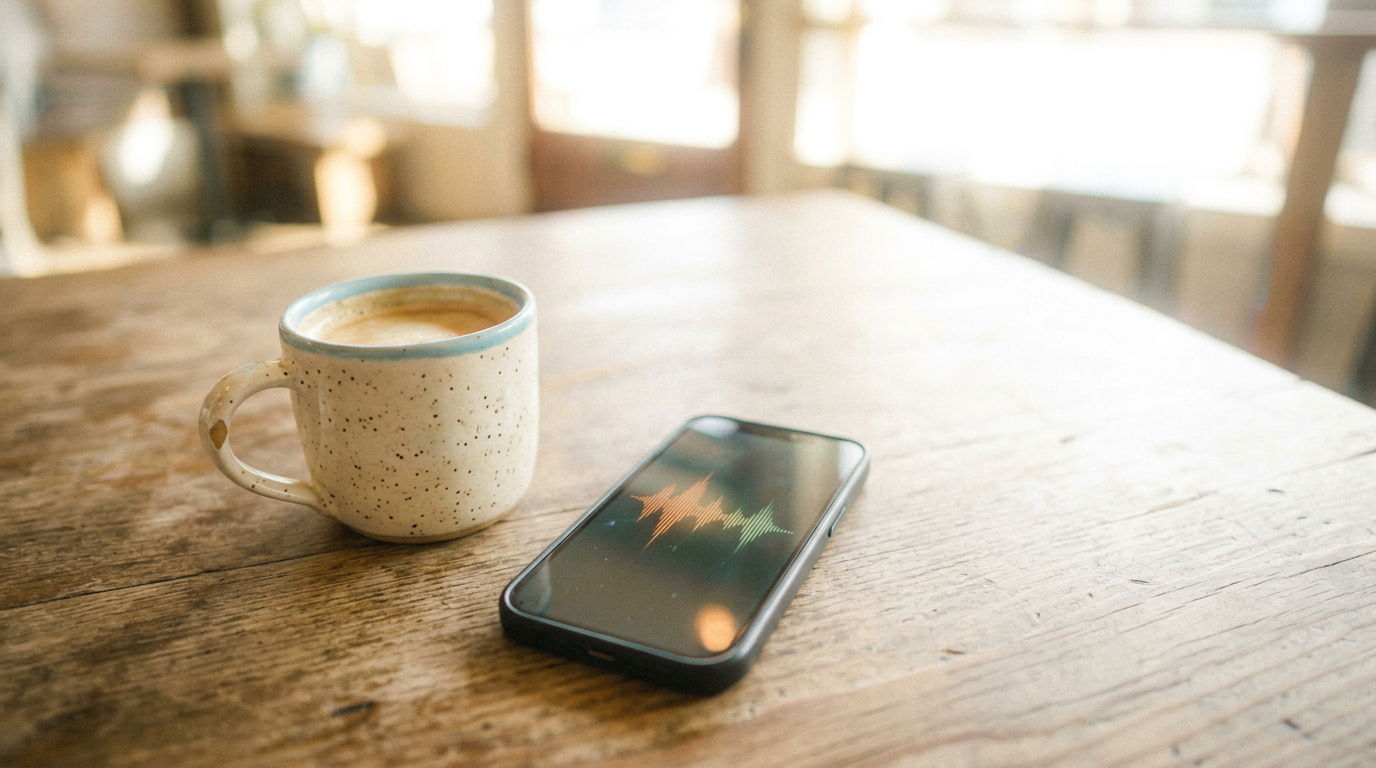
"Just jump in," they say. "Book a live video tutor and force yourself to speak." This common advice suggests that the only way to overcome speaking anxiety is to force yourself into live, real-time video conversations with native tutors. It sounds brave, but for most learners, it is a recipe for panic. Throwing yourself into high-pressure live video calls is a counterproductive way to cure speaking anxiety. Real fluency is built far faster by using asynchronous voice notes to provide a cognitive buffer. When you are struggling to find your words, the last thing you need is a live camera staring at you while your brain goes into survival mode.
Quick answer: To overcome foreign language speaking anxiety, avoid high-pressure live video calls that overload your working memory. Instead, start with asynchronous voice notes. This low-stakes practice lowers your affective filter, gives your brain time to process vocabulary, and builds the linguistic stamina needed to transition to live conversations.
Why live video calls freeze your brain
When you log onto a live video call, your brain does more than search for vocabulary; it struggles under sudden cognitive overload. You have to decode accents, watch facial expressions, ignore your own face in the corner of the screen, and plan your next sentence. According to cognitive load theory, learning and executing a second language is a biologically secondary task that relies heavily on the limited processing capacity of our working memory (Sweller et al., 2011). When you flood that working memory with performance anxiety, the system crashes.
This is a physiological reaction, not just a lack of confidence. Researchers identify foreign language anxiety as a situation-specific psychological reaction (Horwitz et al., 1986) that triggers a fight-or-flight response. Your heart rate climbs, your palms sweat, and your prefrontal cortex—the part of your brain responsible for retrieving words—goes offline.
Video calls make this worse. Seeing yourself on camera and watching the other person's immediate reactions increases performance pressure because you are highly aware of being observed (York et al., 2021). You become hyper-focused on making visible mistakes.
This pressure hijacks communication. Podcasts like Think Fast, Talk Smart explain how high-stakes verbal situations freeze our processing capacity. Episodes of Thinking in English also break down this mental freeze, showing intermediate learners why their brains lock up on the spot. In the book Psychology for Language Learning, researchers show how language anxiety and a learner's willingness to communicate shift constantly based on the environment. When the environment is a high-pressure video call, that willingness drops to zero.
Why a time buffer stops the panic
The solution is to slow down the clock. Sending voice notes introduces a temporal buffer—it simply gives you time to think. Instead of having to reply in 200 milliseconds, you have 20 seconds, or even two minutes, to process what you heard and formulate your response.
This buffer protects your working memory. When you are not forced to react instantly, you can retrieve vocabulary from your long-term memory without panic. The self-pacing of asynchronous audio allows you to shift language production from an anxious survival mechanism to a reflective strategy (Poza, 2011). You are no longer just trying to survive the conversation; you are actually learning from it.
This sense of control directly reduces situational speaking apprehension, transforming high-threat tasks into manageable exercises (McNeil, 2014). You can use tools like Talkling to exchange voice messages with built-in transcription support, or use HelloTalk to swap voice notes with native speakers at your own pace. This is also why audio-first courses like HearSay focus on low-stakes WhatsApp audio lessons rather than live video calls.
Consider the actual speaking time. In a typical 30-minute live video call, you might only speak for 10 minutes, much of it spent in stressful, awkward pauses. Spending those same 10 minutes a day sending structured voice notes gives you 10 minutes of high-density speaking practice. Over a week, that is 70 minutes of active production. Over six months, that equals nearly 30 hours of focused speaking, without the panic.
Lowering your mental barrier
Linguist Stephen Krashen introduced the concept of the Affective Filter, a mental barrier that can block language acquisition. When you are stressed, angry, or self-conscious, this filter goes up. Even if you hear the correct words, your brain cannot process or store them. The video explanation of Stephen Krashen's Affective Filter Hypothesis shows how this stress silences fluency.
Live video calls keep this filter high. You worry about how you look, whether you pronounce words correctly, and how the other person judges you. Real-time voice environments cause anxiety through pronunciation pressure and turn-taking mechanics (Satar & Özdener, 2008). You are forced to jump into the conversation before you are ready, which makes you hyper-aware of your mistakes.
Asynchronous audio shields you from this immediate visual scrutiny. When you send a voice note, there is no eye contact to maintain and no immediate facial reaction to read. This distance lowers the fear of negative evaluation (Satar & Özdener, 2008). By removing the pressure of the live audience, you lower your affective filter. When your brain relaxes, it retrieves grammar and vocabulary much more easily.
Why re-recording is not cheating
Many learners feel that using the re-record button on a voice note is cheating. They think that if they cannot say it perfectly the first time, it does not count. This misunderstanding ignores how the brain learns.
In a live video call, when you make a mistake, you often feel a flash of shame. You might stammer, apologise, or simply freeze. Your brain associates that linguistic structure with stress, which makes you less likely to use it next time.
When you use asynchronous audio, the re-record option acts as a safety net. If you stumble over a verb conjugation, you can delete the message and try again. This process of recording, listening, and re-recording shifts your language production from an anxious survival mechanism to a reflective strategy (Poza, 2011).
This is active self-monitoring. When you listen to your own voice, notice a mistake, and correct it in a second recording, you actively reinforce positive neural pathways. You teach your brain what the correct version sounds like in your own voice, without any associated shame. This is high-efficiency practice, not cheating.
A step-by-step ladder to real conversation
You do not cure a fear of heights by jumping out of an aeroplane. You start by standing on a sturdy chair, then looking out of a second-floor window, and gradually working your way up. Speaking a new language requires the same graduated exposure.
Instead of jumping straight into live video calls, you can build a gradual ladder to real conversation.
First, start with zero-stakes private recordings. You can use apps like Speechling to record short sentences and get asynchronous feedback from a coach. If speaking to a human still feels too intimidating, you can use Langua to practise with realistic AI voices in a judgment-free zone.
Second, move to low-stakes asynchronous voice notes. This is where you start exchanging messages with language partners or tutors. You can also use structured programmes like HearSay, which lets you practise speaking through daily WhatsApp audio lessons and role-play calls. As one learner, Hilary, notes: "Unlike other apps, HearSay actually gets better as you go because it keeps building on the vocabulary you learned."
Third, once your confidence is established, you can step up to live, real-time conversations. By the time you have that first live call, you have already spoken the language aloud for hours. Regularly exchanging asynchronous voice messages over several months leads to statistically significant improvements in overall oral proficiency, fluency, and grammatical accuracy (Andújar-Vaca & Cruz-Martínez, 2017). You are not starting from zero; you are simply speeding up a process you have already mastered.
How slow-motion conversations build stamina
Linguist Margaret Healy Beauvois coined the term "conversations in slow motion" to describe how computer-mediated communication allows delayed but cognitively identical language processing (Beauvois, 1998). When you send voice notes back and forth, you are still having a real conversation. You are still greeting each other, asking questions, sharing stories, and reacting to news. You are just doing it with a pause button.
This slow-motion practice builds real linguistic stamina, letting you focus on sentence structure and vocabulary selection without the pressure of immediate turn-taking. Over time, this translates directly into real-world fluency.
A study on mobile instant messaging found that regularly exchanging asynchronous voice messages over several months leads to significant improvements in oral proficiency and grammatical accuracy (Andújar-Vaca & Cruz-Martínez, 2017). The skills you build in slow motion do not disappear when the conversation speeds up. They form the foundation of your active vocabulary. For more guides on how to build this active vocabulary, you can explore resources like the Thinking in English Blog.
By treating your early conversations as slow-motion exercises, you give your brain the time it needs to automate the mechanics of speech. When you finally transition to real-time calls, you will find that the words come to you much faster, because you have already practised retrieving them in a calm, controlled environment.
Conclusion
Fluency comes from giving your brain the quiet, asynchronous space it needs to build lasting neural pathways. If you want to overcome speaking anxiety, ignore the advice to jump straight into live video calls. Start with a voice note instead.
If you want to build your speaking confidence without the anxiety of live video calls, try HearSay. It is a WhatsApp-native, audio-first language tutor that delivers daily 10-minute lessons directly to your phone, allowing you to practise speaking and role-play conversations at your own pace. Get started today at hearsaylearn.com/get-started or build your own custom course at hearsaylearn.com/create-course.
FAQ
Why do I get anxious when speaking a foreign language?
This anxiety, known as xenoglossophobia, is triggered by a fear of negative evaluation and self-consciousness. It raises Stephen Krashen's Affective Filter, which acts as a mental barrier. This barrier temporarily blocks your brain's ability to retrieve words, causing you to freeze even when you know the vocabulary.
How do I practise speaking a language when I have no one to talk to?
You can practise speaking alone by using active production techniques like self-talk, voice journaling, and shadowing. These methods train your vocal muscles and build neural pathways without any social pressure. They help you get comfortable hearing your own voice in the new language.
How do you overcome the fear of speaking a new language?
Overcome this fear by using a graduated exposure ladder. Start with zero-stakes private recordings to get used to your own voice. Then, progress to low-stakes asynchronous voice notes with language partners. Only move to live, real-time conversations once your confidence and vocabulary are established.
What are the symptoms of foreign language speaking anxiety?
Symptoms are both physical and cognitive, driven by your body's fight-or-flight response. You might experience a rapid heart rate, sweating, a dry mouth, or trembling. Cognitively, it leads to sudden mental blocks where you completely forget basic vocabulary and grammar rules under pressure.
References
Andújar-Vaca, A., & Cruz-Martínez, M.-S. (2017). Mobile instant messaging: WhatsApp and its potential to develop oral skills. Comunicar, 25(50), 43-52. https://doi.org/10.3916/C50-2017-04
Beauvois, M. H. (1998). Conversations in slow motion: Computer-mediated communication in the foreign language classroom. The Canadian Modern Language Review, 54(2), 198-217. https://doi.org/10.3138/cmlr.54.2.198
Horwitz, E. K., Horwitz, M. B., & Cope, J. (1986). Foreign Language Classroom Anxiety. The Modern Language Journal, 70(2), 125-132. https://doi.org/10.1111/j.1540-4781.1986.tb05256.x
McNeil, L. (2014). Ecological affordance and anxiety in an oral asynchronous computer-mediated environment. System, 42, 123-134. https://doi.org/10.64152/10125/44358
Poza, F. (2011). The Effects of Asynchronous Computer Voice Conferencing on L2 Learners' Speaking Anxiety. IALLT Journal for Language Learning Technology, 41(1), 32-56. https://doi.org/10.17161/iallt.v41i1.8486
Satar, H. M., & Özdener, N. (2008). The effects of synchronous CMC on speaking proficiency and anxiety: Text versus voice chat. The Modern Language Journal, 92(4), 595-613. https://doi.org/10.1111/j.1540-4781.2008.00789.x
Sweller, J., Ayres, P., & Kalyuga, S. (2011). Cognitive Load Theory. Springer Science & Business Media. https://doi.org/10.1007/978-1-4419-8126-4
York, J., deHaan, J., & Hourdequin, P. (2021). Effect of SCMC on foreign language anxiety and learning experience: A comparison of voice, video, and VR-based oral interaction. ReCALL, 33(3), 281-298. https://doi.org/10.1017/S0958344020000154